


In this’s BigCommerce review, I’ll be looking at one of the most popular ecommerce store builders on the market today.
BigCommerce is a scalable and convenient tool, with a host of built-in features designed to help business owners thrive online.
Quick verdict:
I believe BigCommerce stands out as a powerful, adaptable, and user-friendly platform, designed to scale with various business models.
Distinct from other ecommerce solutions, BigCommerce includes nearly all essential tools for building your online presence in its core offering, eliminating the need to rely on additional plugins and extensions for expanded capabilities.
While BigCommerce might not be quite as versatile as alternative solutions like Shopify, it does provide companies with a convenient bundled package for online selling.
Even the pricing for BigCommerce is relatively fair, particularly if you choose an annual plan.
BigCommerce is designed for people without programming and coding knowledge, so even beginners who have never worked on a website before can still take advantage of the platform.
Overall, we consider this tool to be an excellent option for all kinds of business leaders.

- Free Trial
- From $29.95/month
- Built-In Blog
- SEO Friendly
- App store
BigCommerce Video Review

What are the Pros and Cons of BigCommerce?
All Ecommerce store builders have their own benefits and disadvantages to consider, and BigCommerce is no exception.
The Pros of BigCommerce do generally outweigh the cons, but it’s worth being aware of exactly what you’re going to get with this platform.
BigCommerce Pros 👍
- No platform fees, commission fees, or transaction fees on any plan
- Unlimited staff accounts on every package, making it excellent for teams
- Integrations with a range of leading payment gateways
- Marketplace and social media integrations for Amazon, eBay, Facebook and so on
- Free site-wide HTTPS dedicated SSL
- Mobile app access for managing and updating your store on the move
- Real-time shipping quotes, coupons, discount rules, and gift cards
- Product ratings and reviews available on every plan
- Competitive pricing for local payment methods for omnichannel selling
- Strong SEO support to enhance organic growth
- Use-centric, built-in features to minimize the need for apps
BigCommerce Cons 👎
- Slight learning curve for beginners
- Small-scale sellers might find the product too complex
- Revenue-led billing can be a problem for some companies
- Certain features can come with additional costs
- No free plan available for smaller companies
- Customer service and support may be slow at times
BigCommerce Top Features
As I noted above, one of the things that makes BigCommerce such a compelling choice for many business owners, is that it already comes with most of the tools you need to develop a store already built-in.
This means you shouldn’t need to spend a fortune on extra apps and add-ons for running and optimizing your website.
The exact features you’ll get from BigCommerce will vary depending on the plan you choose. However, most plans come with some excellent capabilities.
BigCommerce provides a suite of impressive features that include:
- Complete store design tools: You’ll be able to design your own online website with a range of 12 free themes, and a host of premium themes. The templates are mobile responsive and customizable through a drag-and-drop page builder. There’s also the option to experiment with CSS and HTML code if you have the right technical knowledge.
- Selling for a range of products: Store owners can sell unlimited products on all of BigCommerce plans. You’ll be able to choose from physical and virtual products in all of the categories you like. There’s even the option to implement dropshipping add-ons and plugins if you choose. Plus, you can use the shipping rates of your choosing.
- Payment gateways: BigCommerce integrates with a range of payment gateways, including PayPal, and Stripe. You can accept various different payment methods, including credit cards, mobile wallets, and smartphone solutions like Apple Pay and Google Pay. Plus, you’ll be able to customize your checkouts into a single page depending on your needs.
- Staff accounts: All BigCommerce plans come with access to unlimited staff accounts, with access controls, so you can determine exactly what each employee will be able to do with your store. This ensures you can work as part of a comprehensive team to build an engaging website, and even manage customer service.
- Apps and integrations: Although BigCommerce includes most of the functionality you’ll need to build your store as standard, you can still use the app market to extend your store’s capabilities. There are various tools available for marketing, sales, dropshipping, analysis, and more, so you’ll have no problem scaling your website with additional features.
- SEO: Like many leading ecommerce website builders, BigCommerce comes with tools for managing search engine optimization already built in. You can adjust your URLs, meta descriptions, alt tags and descriptions to ensure your site has the best chance of ranking online. There’s also blogging functionality available for content creation.
- Abandoned cart recovery: Though it’s not offered on the cheapest plan, the rest of the BigCommerce packages do offer abandoned cart recovery features so you can connect with customers and pull them back to your website when they fail to complete a purchase. You can even personalize each email you send to boost your chances of a sale.
- POS integrations: BigCommerce syncs online and offline payment options and sales automatically, so you can track your shop’s performance across a range of different channels. In fact, BigCommerce has more POS integrations than virtually any other ecommerce platform, giving businesses excellent flexibility and freedom.
- Shipping options: BigCommerce offers a range of shipping options, including real-time shipping quotes, free shipping, and custom shipping labels. You can even download the BigCommerce shipping app for free and get special exclusive discounts. Shipment tracking, in-store pick-up and next day delivery are also included.
- Reporting tools and analytics: You’ll be able to leverage a range of custom reports and analytics helping you to track your most valuable products, and increase your potential for long-term sales. For beginners, BigCommerce even offers an opportunity to work with a professional on a full, personalized site audit.
- Mobile apps: It’s easy to manage your store from anywhere with Android and iOS mobile apps for BigCommerce. You can view or edit products, fulfil orders, and even connect with team members on the go. There’s even the shipping app available for your smartphone which will give you access to discount shipping rates.
BigCommerce Introduces AI Features
BigCommerce is currently developing an AI toolkit, called “BigAI”. This toolkit shares several similarities with “Shopify Magic“, the suite of AI tools offered by Shopify. BigAI provides users with the ability to instantly generate content, gain insights through predictive analytics using Google BigQuery ML, and offer personalized product recommendations to customers. Further, it enhances customer search results with its AI-powered search functionality.
Moreover, BigCommerce is collaborating with various other companies to introduce AI-enabled integrations on its platform.
Read more:
What is BigCommerce?
BigCommerce is an ecommerce website building platform, focused on supporting complete beginners in their quest to build the ultimate website.
Founded in Sydney, Australia, during 2009, BigCommerce has evolved over the years to become one of the most feature-rich platforms around, with everything companies need for search engine optimization, store creation, marketing, and security.
BigCommerce is a SaaS “hosted” premium ecommerce solution, which works on the software-as-a-service business model.
In other words, when you pay to access BigCommerce, you’re not buying a version of the software, but instead “renting” the platform to help you sell your products online.
Best for large businesses

How Does BigCommerce Work?
The hosted solution operates on its own servers, so you don’t need to install any software to use it, or purchase separate web hosting.
Additionally, as long as you can access the internet and a web browser, you can manage your store from anywhere.
BigCommerce is similar to a lot of ecommerce platforms in its functionality. You can use it to sell physical or digital goods, and there are a range of templates included in the platform to help you get started with building your store.
While BigCommerce is aimed at people without any design skills, it does allow developers to customize their stores further with CSS and HTML editing.
BigCommerce Tutorial – Video
In this comprehensive tutorial, we’re going to delve into the essentials of using BigCommerce, a leading e-commerce platform known for its robust features and user-friendly interface.
We’ll walk you through the setup process, how to add products, and tricks to optimize your online store for more sales.

How We Tested BigCommerce
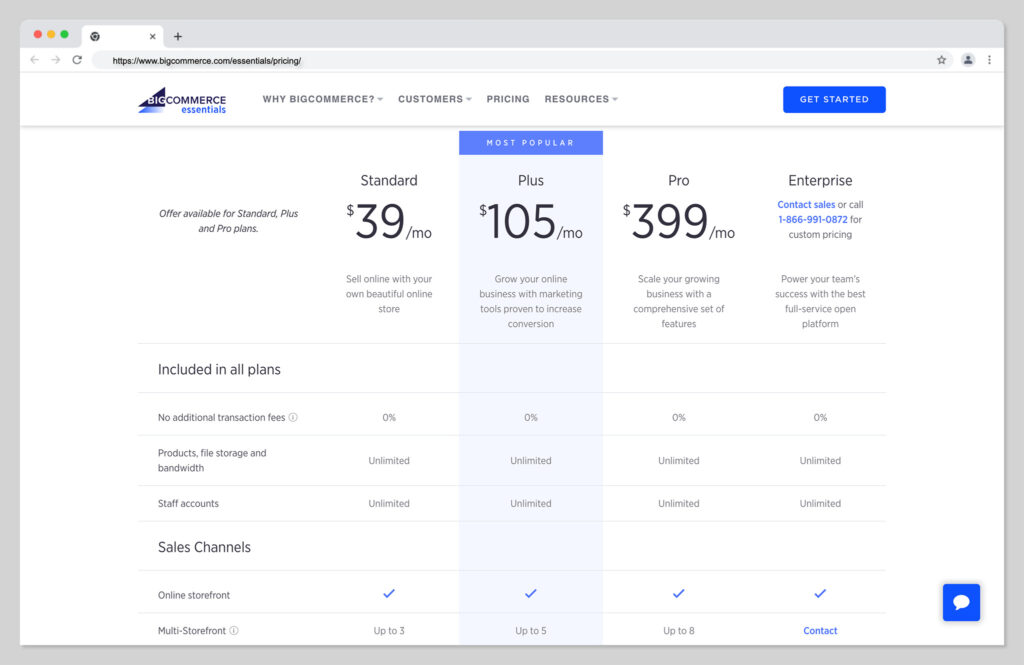
BigCommerce Pricing Plans
Here are the princing options available:
- Standard: $39 per month
- Plus: $105 per month
- Pro: $399 per month
- Enterprise: Custom Pricing
Pricing will always be a core concern for any business owner investing in new software, tools, or solutions for their online presence.
As mentioned above, I consider the BigCommerce plans to be relatively fair, based on the functionality you’ll get. However, some people may find these packages unusual, as they’re linked to business revenue.
You can try BigCommerce for free for 15 days before picking a plan. We’d also recommend considering the annual plans if you’re committed to using BigCommerce as your store builder, as you can save 25% on the total cost of your package.
Comparing the Various BigCommerce Subscription Options
Standard: $39 per month
The Standard plan from BigCommerce allows users to sell unlimited products, access unlimited staff accounts, and leverage a range of sales channels. You can connect to eBay, Amazon, Facebook, Google Shopping, and more.
Coupons, discounts and gift cards are all included, and you can integrate with a host of leading payment gateways, without having to pay extra transaction fees.
The Standard plan allows you to sell up to $50k of products and services annually, and supports POS integrations for combined online and offline selling.
There’s a free SSL certificate included in the plan, support for product ratings and reviews, and even real-time shipping quotes.
Plus, you’ll be able to access competitive pricing on local payment methods. This is a great starting plan for beginners, with a lot of included features.
However, you don’t get abandoned cart recovery, which could be a problem for small businesses looking to sale.
Plus: $105 per month
The Plus plan from BigCommerce, which starts at $79 per month when billed annually, includes all of the features of the Standard plan, while giving you the option to sell up to $180k per year.
You can also leverage an abandoned cart saver, customer groups and segmentations, and persistent carts.
The Plus plan allows for credit card storing, as well as the option to arrange customers into groups based on their value or shopping habits.
This is perhaps the best value package from BigCommerce, and it’s well worth considering, even if you’re under the revenue threshold currently. For growing businesses, this is our number one plan.
We recommend…
The Plus plan is the number one plan we’d recommend for BigCommerce. It provides all the features of the Standard plan, plus some very valuable added extras, such as the ability to create more revenue, and leverage abandoned cart capabilities.
Pro: $399 per month
Available for $299 per month when you pay annually, the Pro plan includes everything in the Plus plan, with some added extras.
On this package, you can sell up to $400k annually, access faceted search and product filtering capabilities, and leverage a custom SSL.
This plan is a good step up if you’re scaling your business and want to sell more products without incurring additional fees and complexity.
Enterprise: Custom Pricing
For the biggest ecommerce sellers, BigCommerce offers the Enterprise plan.
This is a custom-priced package which includes all of the features from the Pro plan, as well as some bonuses like Priority support, API support, and custom facets (product filtering) options.
You can also create price lists.
The Enterprise plan is a fantastic option for larger businesses, but it’s not necessary for many smaller companies still in the midst of scaling.
If you’re selling more than $400k worth of products and services per year, you can always upgrade your revenue limit on the Pro plan.
BigCommerce Fees
While BigCommerce doesn’t charge transaction fees on any of its plans, there are some additional fees you’ll need to consider when you’re setting up your store.
For instance, you’ll still need to pay payment processing costs, which can vary depending on the provider you choose.
The good news is you can leverage cheaper local payment methods and card rates depending on the plan you pick.
The more advanced your plan, the cheaper your payment method fees will be. This is good news if you’re going to be scaling your store with BigCommerce.

The payment processing fees included with BigCommerce are similar to those offered by other ecommerce platform vendors like Shopify.
They start at around 2.9% plus 30 cents, then reduce to 2.2% plus 30 cents on the enterprise plan.
Alongside payment fees, you may also need to consider costs such as the price for premium themes and extra apps or add-ons.
If you want to get extra support from a BigCommerce consultant or technical expert, there’s an extra fee to pay there too.
You’ll need to contact the team to find out more about how much you’ll pay for your support.
Ease of Use
So, is BigCommerce user-friendly?
While a feature-rich ecommerce platform is great for any business owner, it’s important to ensure you can comfortably use the tools available to you.
BigCommerce is a relatively straightforward platform, but it’s often considered to be a little more complicated on average than tools like Shopify.
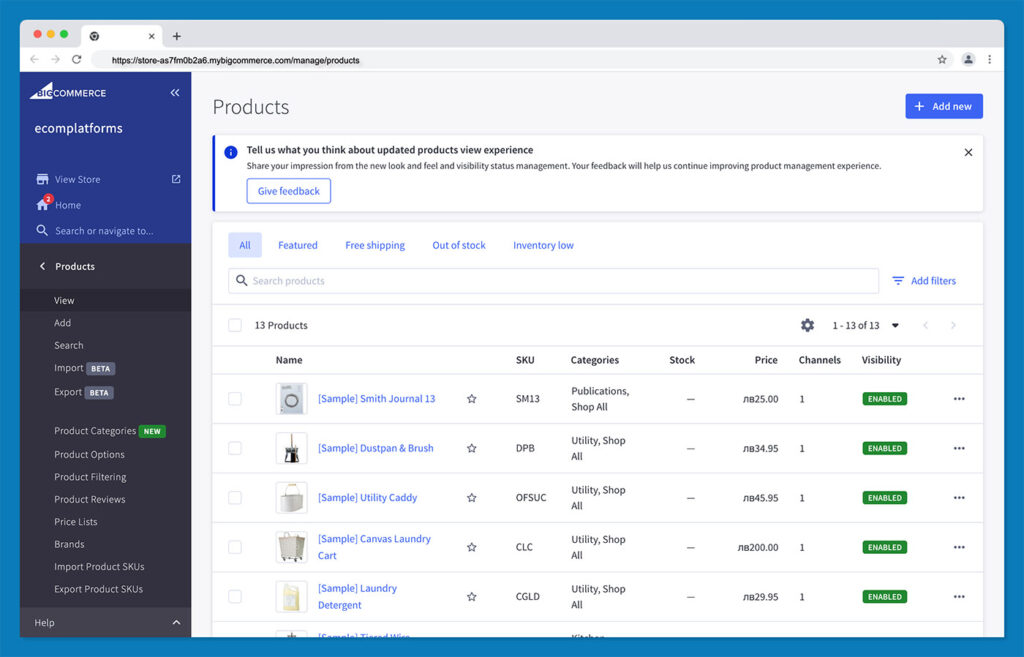
The main issue we have with BigCommerce is the design interface. When you’re creating your online store with BigCommerce, your design interface will be split into two areas – the behind the scenes components of your store, and the visual storefront.
While this might not seem like a problem, it can make it harder to ensure everything is working exactly as expected when you’re building your store.
We’d recommend starting with the back-end and making sure your inventory and other components are set up correctly before you start working on visual design.
Upload all of the products you want to sell, along with their SKU data, then go to the editor for the storefront solution to personalize the overall design.
One point worth noting is that BigCommerce is actively working on making it’s platform a little more straightforward.
The company introduced a visual merchandising tool known as “Store Design” in recent years, which allows users to see exactly how their edits are going to influence the performance and UI of their store. However, there’s still a bit of a learning curve here.
Another thing we should point out is that the rich functionality BigCommerce offers can be a bit of a double-edged sword.
On the one hand, you do get most of the functionality you need to build an effective store in one convenient place, without the need for apps and add-ons. On the other hand, this means you’re going to have more features you’ll need to learn how to use along the way.
Each functionality comes with it’s own components and challenges to think about, whether you’re setting up a POS integration, or managing omnichannel selling.
One thing I do appreciate about BigCommerce from an ease-of-use perspective, is that it makes it extremely easy to get specialist support if you need it.
There’s the option to access personalized site audits and tailored advice from BigCommerce experts. Plus, a community forum is available with webinars, guides, and tutorials.
Overall, I’d say BigCommerce is reasonably easy to use, once you get the hang of it, but you’ll need to commit a decent amount of time to initially setting up your store and getting your head around all of the functionality.
Themes and Templates
One slight problem you may have with BigCommerce, is that the free templates and themes are pretty limited. While there are more than 100 themes to choose from, only around 12 of them are free.
You’ll need to pay an extra cost for the majority of the templates, which can add up to a problem for smaller companies looking to maintain a low budget.
On the plus side, BigCommerce does make it relatively easy to find your perfect theme. You can search through the options by industry, or focus on pinpointing a specific layout.
You can choose from grid layouts or designs featuring large images.
Plus, there’s the option to filter by “free” themes if you’re looking to save some extra cash.
The functionality and appearance of each theme depends on the industry you’re looking in. However, you can preview each theme before you select it.
There’s also the option to switch your theme at any time if you decide it’s time for a change. All of BigCommerce’s themes are mobile responsive, and will automatically format themselves to suit any device.
The Store Design Tool created by BigCommerce ensures you can make customizations to your store relatively quickly.
You’ll be able to pick out sections of your theme and edit them piece-by-piece, changing background colors, logo positions, featured products and more.
BigCommerce App Store
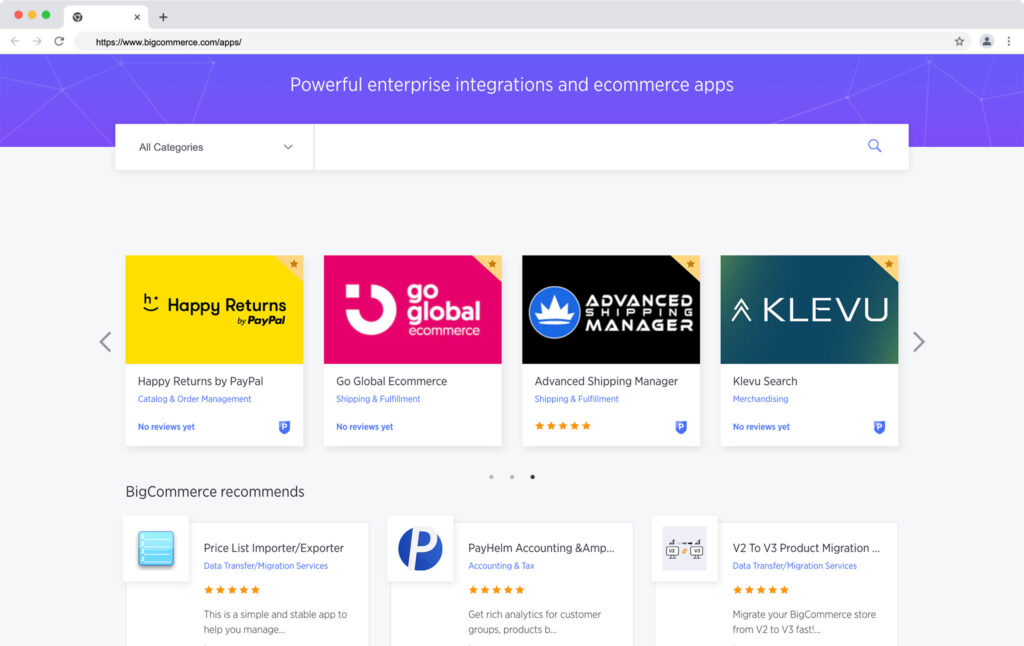
Like many Ecommerce platforms today, BigCommerce does provide companies with the opportunity to expand their store’s functionality through additional apps and plugins.
You can leverage a range of tools within the app store, intended to help you with everything from selling to marketing.
Some apps are available for free, while others will have an additional monthly cost.
Options range from solutions like Quickbooks online for Accounting, to MailChimp for email marketing, JustUno, Print on Demand apps, and a range of fulfilment and shipping apps. You can also leverage a host of marketing tools to help with boosting your online presence.
POS Solutions
BigCommerce also offers integrations to companies looking to combine their online and offline selling strategies.
For instance, you can connect your digital store to point of sale solutions from Square, Clover, Zettle, PayPal, Vend, and many others.
It’s worth making sure you research each of the options on offer from BigCommerce carefully before you decide on one.
However, compared to other major ecommerce vendors, BigCommerce does give retailers a lot more choice to work with.
You’re free to design the ideal offline solution for your store, regardless of whether you’re running a pop-up shop, or a full-time retail location.
Selling Digital Products with BigCommerce
As mentioned above, you’re not stuck exclusively with selling physical products when you start your BigCommerce store.
You’ll also be able to sell digital items too. BigCommerce allows companies to sell anything from digital tools and templates, to downloads, webinars, courses, and more.
One point to keep in mind is that you will be limited in the size of the file you can upload. The maximum file size for a digital product on BigCommerce is 512MB, which is a little lower than you’d get from an alternative like Shopify.
You can bulk-upload products with CSV imports, which is a good way to save some time. You can also consider using add-ons to deliver larger files to your customers if you need to.
Selling Globally with BigCommerce
Another point worth noting is that ecommerce sellers on BigCommerce can essentially sell items to customers anywhere in the world.
In fact, virtually every theme available for BigCommerce (including the free solutions) come with multi-currency solutions built in.
This functionality actually automatically converts the currency shown on your product pages based on your customer’s IP address, which is handy.
If for any reason, the theme you’re choosing doesn’t support this feature, you can always consider downloading an add-on to do it instead.
Overall, though, BigCommerce is great for global selling, and offers more functionality than some other alternatives like SquareSpace.
Even Shopify won’t allow you to set your own currency conversion rates in the same way as BigCommerce unless you’re on a more expensive plan.
Customer Support
No matter how amazing your chosen ecommerce website builder is, there’s always a chance you’re going to need a little help dealing with issues from time to time.
That’s why it’s so important to ensure your solution comes with excellent customer support.
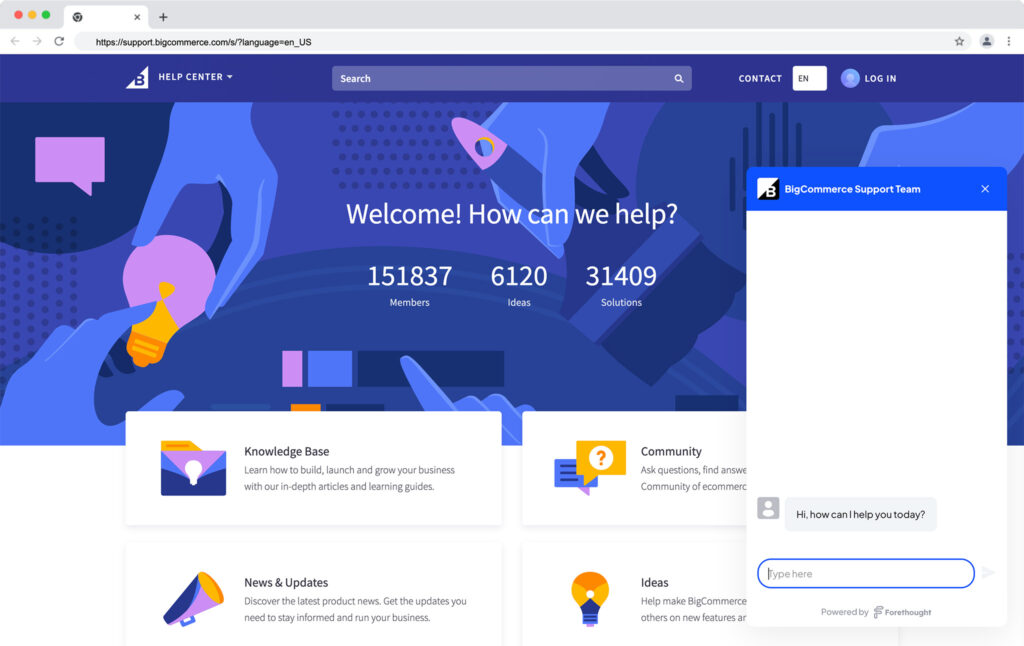
The customer support you get from BigCommerce will vary depending on the price plan you choose. However, as standard, the company does offer 24/7 phone and live chat support, which is excellent for most companies.
There’s also email support available too.
On top of that, you can leverage the BigCommerce help center to find quick solutions to your problem, which includes a ton of blog posts, FAQs and video tutorials to help you.
If you need extra support, you can connect with the BigCommerce support team to get access to technical and auditing professionals too.
BigCommerce User Reviews
To help us get a clearer idea of how other users view BigCommerce, we also took a look at the ratings and testimonials published across the web. Here’s what we found out.
On TrustRadius.com, BigCommerce has a rating of 8.1 out of 10 overall. Customers appreciate it’s excellent level of customization options, the robust range of online payment solutions, and the flexible online shopping cart offered by BigCommerce.
On G2, BigCommerce is rated at around 4 out of 5 stars, with a total of 447 customer reviews. The top-rated features mentioned by customers include payment processing, performance and reliability, and comprehensive control of admin access rights.
Overall, most consumers seem to view BigCommerce as an effective, valuable tool for ecommerce. However, the company has received some negative reviews for its lack of extensibility (limited integrations).
Some customers also feel BigCommerce is slightly harder to use than other well-known solutions like Wix, Shopify, and Squarespace.
Dropshipping with BigCommerce
One good thing about BigCommerce, is that it does support companies in creating a wide range of different types of online business and store.
You don’t necessarily have to handle fulfilment, logistics, and shipping yourself with a BigCommerce site.
The solution offers a range of dropshipping integration options, so you can outsource aspects of your business operations to another vendor.
The easiest way to enable dropshipping within BigCommerce to install one of the available apps on the BigCommerce marketplace.
There are nearly 40 different apps to choose from, including a range of popular favorites like Spocket, Inventory Source, Printful and Printify.
Notably, while some of these apps are free to use, others will include a monthly subscription fee, so it’s worth taking this into account before you choose your app.
What are the Top BigCommerce Alternatives?
BigCommerce serves as an excellent e-commerce platform for numerous vendors, yet it may not perfectly suit every entrepreneur’s needs.
Certain constraints, particularly regarding user-friendliness and expandability, are present. For those seeking different solutions, we suggest considering the following leading alternatives:
1. Shopify – Best Overall BigCommerce Alternative
Our all-around favorite platform for ecommerce websites, Shopify offers endless functionality, with exceptional ease of use.
The platform might not have as many built-in features as BigCommerce, but you can easily extend the functionality of the platform with add-ons and integrations.
Shopify Review – Video
Don’t forget to watch this video version of our Shopify review for more info.
Shopify is fantastic for store owners of all sizes. Plus Shopify offers access to a range of marketing features and tools to increase the number of products you sell.
2. Squarespace
One of the biggest downsides of BigCommerce is it only has a limited number of themes and design options to choose from.
If you want a more design-focused ecommerce store builder, Squarespace is a fantastic choice. It has it’s own easy-to-use drag and drop editor, as well as dozens of professional templates and themes.
Just keep in mind the ecommerce features on Squarespace are a little limited when compared to BigCommerce.
3. Wix
For ease of use, it really doesn’t get simpler than Wix. You can even use AI solutions to build your own site with minimal effort or customization. Wix gives companies everything they need to build highly responsive sites in minutes.
Plus, it offers far more options when it comes to customization and templates than BigCommerce. However, Wix might not be the most scalable solution as your business begins to grow.
4. Square Online
If you’re running an omnichannel business and want to sell both online and offline at the same time, Square Online might be your best bet.
This incredible tool comes with an easy website builder you can leverage for free. Plus, there are specialist features available for those in the restaurant and retail landscape.
The point of sale features are excellent, as are the inventory management and syncing options.
5. Ecwid
If you already have a website on WordPress or a similar platform, then Ecwid could be an excellent way to add ecommerce functionality to your site with a third-party app.
You can leverage the tool as a plugin, or use it to build your own simple store – though the functionality available is limited compared to what you get on BigCommerce. Ecwid is extremely affordable and easy to use, and it offers various options for multi-channel selling.
👉 In this aricle you will find my list of top 10 BigCommerce alternatives along with a short review of each to be useful.
BigCommerce Review: Verdict
Overall, we consider BigCommerce to be an excellent tool for building an ecommerce business. While it may not offer the same flexibility as a solution like Shopify, it does come with a lot of great features already built-in, including multiple payment gateway options.
Plus, it won’t charge you any transaction fees on any plan, so you can save some much needed cash.
We’d recommend BigCommerce to anyone in search of a relatively convenient online store builder, capable of supporting omnichannel selling and even POS integration.
The platform has excellent analytics and reporting tools, strong SEO support, and a handful of great integrations to choose from. However, the learning curve might be a little too high for some absolute beginners.
While it’s not as complex as building a store from scratch with WordPress and WooCommerce, the overall rating of BigCommerce from most users is hampered by its ease of use.



BigCommerce has serious billing and accountability issues. My account was canceled months ago, and they debited $863.46 for renewal yet are not refunding or canceling the account. Their system is clearly having issues, as now their cancellation form will not even resubmit a cancellation request. I strongly urge others to use a different company. BigCommerce is bad business.
Sorry to hear that Stacey.
We have the same issue. Have not sold anything on the site for over a year. Still charging the rate based on previous year sales of 700,000. Finally had to cancel, would not refund money basically stolen from us.
The following is to express how DISAPPOINTED and FRUSTRATED my partner and I are with the customer support and service provided by BigCommerce for an issue THEY are responsible for. A couple weeks ago, my partner, who is a small company owner, decided to set up an account with BigCommerce. Problem is, there was a ‘’glitch’’ in their API making it so even if the USD$ currency was set up correctly on our part (as well as the Paypal one), the first few transactions were converted in CAD$, making us lose about 30% of the value of our first few sales because of the exchange rate. It took more than a dozen emails and phone calls before they even acknowledge the problem came from their system/API. Not to say that a few emails were left unresponded and ignored for more than a week (if not answered with ‘’canned’’ generic responses that were absolutely useless).
My partner took the time to find where this ‘’glitch’’ came from, in the Bigcommerce system, and he wrote in detail the issue & solution to the ‘’escalated manager/product support engineer’’ who still blamed the situation on Paypal. After weeks of this nonsense, they still wouldn’t acknowledge the mistakes was theirs – when it was in fact a problem with their API system set up. But on our part, we still hadn’t got our money back, not even a deal from BigCommerce to apologize for the inconvenience. Even after all of this back and forth with them, my partner was still highly cooperative, being open to suggestions as to how BigCommerce could help us recoup these funds in the form of BigCommerce subscription credits in the value of the lost currency (approximately 30% of the 3 aforementioned orders’ values).
After a month this is the answer we were provided with by BigCommerce : ‘’…to be completely transparent, we cannot 100% confirm that this was a bug produced by us. We work diligently to resolve issues with software, however we do not offer a refund if those issues impact store functionality, but we are willing to compromise and offer this credit (of 29 USD$) as a gesture of good faith. Unfortunately, we do have bugs that come up in the platform and even cases where checkout might not work at all. In these cases, we do not refund everyone because of these problems but simply have our team address the issues as soon as our clients report them. ‘’
BigCommerce is a multi billion dollar company that develops e-commerce software for businesses. A 29 USD$ credit offer is highly offensive for this kind of situation. You have one job : provided business with functional e-commerce system and where there is, fix the problems in your software so YOUR CLIENTS, US, BUSINESS OWNERS, continue to do business with you. I think it’s a pretty simple request. We know bugs and issues can happen with technology. What’s HIGHLY UNACCEPTABLE on your part is this unwillingness to cooperate and offer us and legitimate compensation to our actual loss. Which we’re pretty sure you can afford because it is far from being millions of dollars.
We’ll make sure to share our experience with other business owners and potential clients so they know what to expect in case of future software issues.
Thanks for sharing Sophie!
BIGCOMMERCE is EXPENSIVE and falls short in some features.
If you plan to grow up your business, big commerce will charge you for your success. More sales, more charges. Another critical technical issue they have and they cannot resolve is the lack of drag and drop feature to sort items into each category, this is a KEY feature for stores with many items that need to be organized -displayed into different categories. in a fashion way. If you have an item that fits into 2 or more categories, the item will repeat the same position in those categories. cannot be arranged unless you start duplicating items. If you want to move up or down an item, you have to make a huge work on CSV format. Ridiculous. Another issue to take in the count is the lack of good apps, they do not offer the most popular. I think there are other good options out there before moving your e-commerce here and then face the issues. Once you grow up is hard to move out.
Thanks for posting your review.
I spent over 2 years on BigCommerce, 2+ years I’ll never get back. I moved to BC from a semi-successful ProStore after a delightful rep made a lot of promises (no guarantees, but lots of promises) that my e-commerce sales would jump through the roof with unmatched ease-of-use, simple back-end setup (NOT!) and top-notch SEO. When using all of the SEO tabs, adding products was super labor intensive. At the time, I had no idea what a meta tag was & BC offered no explanation. CS reps didn’t help – they just made me feel like an idiot, if they responded at all. Usually , they didn’t. When they did, it might take 2 weeks and multiple requests for help to get even a simplistic, unhelpful response they punched out over a sandwich.
My sales dropped to 0, even after I spent thousands on independent SEO. When I emailed BC, desperate for help, I received a 5-word response: “Add tags to your images.” Period. Not even a “Thank you for contacting us.” Had that CS rep bothered to look, he would have seen that all of my images had been tagged from Day 1. If CS can’t even take the time to view a troubled account, they have no business adding “service” to their job titles.
I hated the idea of giving up after years of hard work and financial investment, but too many unanswered begs for help made me realize that throwing good money after bad (Pro level) wasn’t the answer. After a short stint with the very limiting web.com, Shopify here I come.
After being their customer for many years, i am totally disappointed at BigCommerce especially as they try to milk the accounts. Now we cannot install our own EV SSL unless we upgrade to a plan that pays them thousands per year, and also pay 2.5x the fee for an EV SSL from them. I had to cancel my EV SSL that i purchased with GoDaddy for half the price. Complete monopoly and they should be sued for anti-trust anti-competitive behavior. Next stop they will want to share your revenue if you do not use their partner credit card processing system. This is a free country i install whichever SSL i want, i use whichever merchant service i want, BigCommerce is not to be trusted it anywmore. I have been their customer since their interspire day, and today i am pissed off. Steer away from it. I am a current customer and none paid me to write this. I am truly angry and they are trying to fix their free SSL which is not working on my website. zero orders today and tomorrow to please their greedy management.
I having been using Bigcommerce since 2009 when it was open-source platform and called as Interspire. What attracted met to Bigcommerce was the ease of configuring it, and common-sense navigation. I could quickly find and setup things I wanted to.
Its still the easiest to use platform, no doubt. But there are several problems which unfortuantely doesnt make it a good deal anymore, and I am planning to switch over soon.
1. There have been several features merchants have been requesting them since years back. But they have never implemented the same. For example – ability to set Custom Order Status. They spend their time and resources on developing features that can attract new customers, but are least bothered about implementing features existing customers are yearning to have.
2. Support is a joke, and expect your problems to prevail for a very long time. I had asked them to add a missing state of a country to the checkout process 2 years back, and its still pending !
3. There new Stencil framework for developing the UI is developer friendly, but its insanely difficult for merchants with limited technical expertise to do small tweaks. Their previous framework called “Blueprint” was much user-friendly and one could do lot of on-browser changes. I believe they have gone backward in front-end design. Shopify has a very efficient simple way to organize various elements for your home page, on browser itself. With stencil all you can do is change colors, and size of elements on browser. for everything else you need to download theme, do offline edits and then re-upload. The process looks very rudimentary and you are stuck having to book developer everytime small changes are required.
4. Bigcommerce is solely dependant on company called Pixel Union for new themes. The new themes are good looking but one can easily find bugs/shortcomings in each one of them. None of them look complete, specially when you have a big catalog to fit in. There is death of new ideas been showcased as only one company keeps contributing. Bigcommerce as such have developed only 2 themes and they are just ok. You wont find many bigcommerce themes available offline too.
5. Most of the new features developed are for USA market, sometimes EU. Rest of the world is ignored. If you are a merchant outside USA, expect many modules would not be usable.
6. It has very limited payment processors integrated. If you are outside USA, expect very few or no options available.
7. Checkout process is very old-fashioned with accordion kind of view. Customers cant see which products they bought on the checkout page, which results in lot of lost conversions. Company has introduced a new check-out page, but it is limited to few payment processors and currencies. I still don’t understand the point why it cant be rolled out for everyone irrespective.
8. Product Filters or faceted search is heart of ecommerce. It allows customers to find their products quickly, and it goes without saying that its a must-have feature. Bigcommerce was very late to understand and implemented this after thousands of merchants requested them for it. But they saw an opportunity and pain point, and capitalized on it by offering it only on their high-end plans. If you need to build custom filters, then you have to go straight up and opt for Enterprise plan. The whole Merchant community have been betrayed by this, and have no option left rather than to change platforms or upgrade to higher plans.
As such I feel very pained to know that a platform I once loved is disappointing me further with every other day I stick to it. My search for an another platform has started…..
On a positive note, BigCommerce announced the release of many new themes built on Stencil, custom order status is coming, and their new optimized checkout eliminates the accordion of the old style checkout. They’ve also heard our cry that the live chat support has been horrible and are bringing it back to the US along with better trained reps. They are improving the way they listen to customers’ needs and have become more responsive.
I just started using BigCommerce and i’m really worried now because of all this bad feedback, i already paid for it…I feel like i wasted money if is that bad and i want an ecommerce that i can have my store hosted for many many years but it seem like BigCommerce was a wrong choice for what i have read…Wish i could read all this before paying for the service there, should i cancel it now? Help!
BigCommerce Reviews : BigCommerce has proven to be a significant burden and a huge financial loss on a business processing over $650k on this platform.
The customer service lacks basic knowledge of server issues, known engineering issues (including auto-refunds to customers), unknown third-party scripts placed by their engineering team, etc.
I would not recommend it if you are migrating or considering scaling your business up.
The new Stencil ‘upgrades’ are littered with random javascripts that are not pertinent to the site. BigCommerce claims they are aware of the issue, but have done little to rectify it in over a month. The data is either being gathered and sold, or it is a major engineering issue which is causing drastic load times.
Major issues:
-Load times: Exceed 20 seconds according to Google Analytics. This is based on hidden scripts.
-API Payment Issues: BigCommerce has emphasized their integration with Braintree. Yet, their API is significantly flawed. The system issues automatic ‘void’ pings to Braintree which has caused thousands of dollars lost.
-Many services have been ‘offered’, some have been implemented, but nearly 50% of the services discussed seem to be canceled.
In addition to the aforementioned, other issues relate to the terrible pricing structure. It requires constant upkeep to find workarounds for BigCommerce engineering issues. However, hosting fees exceed $6,000/year.
I’ve been blamed many times for issues caused by engineering, but after discussing and providing multiple screenshots, the Customer service finally acknowledges that it is an internal issue. Unfortunately, this takes about 10 hours a month and there’s NO COMPENSATION for the issues they have caused.
Thanks for posting your review Richard!
I was a customer with Bigcommerce for 3 or 4 years. In the start they were decent providing a 4/5 service at a good 4/5 price. Since starting with them they really didn’t improve their features much and their service started to go down a little from an albiet pretty good level.
Then they implemented their much talked about price change. They charged a monthly fee based on the plan used. Their plans ranged from quite basic right up until an entreprise level and a few in between. It was very easy to understand and very transparent.
Their new pricing model is to charge the customer how many sales transactions they do not on how many resources are used. A content management system like bigcommerce is a generic service, they are not your partner. Therefore they do not have the right to get a cut out of your sales when you are more successful.
Adding to this their features haven’t kept up with their competitors over the last few years.
We cancelled bigcommerce and moved to another provider and couldn’t be happier to get rid of this company
This is a horrible e-commerce company to go with. We chose a design partner highly recommended by BIG COMMERCE, the partner hacked our code so that we could not convert, BIG COMMERCE TECH Support lied to us and continued to cover for their corrupt design partner. We lost thousands of dollars, do not go with BIG COMMERCE, horrible experience, awful tech support, corrupt and unethical business practices.
i had nothing but really bad experiences with Big Commerce. You get a different answer every time you call, and have no idea what they are doing. Worst, i understand one can make mistakes, but at least take responsability for it!…Which they absolutely do not. They obviously have poor customer service and seems to me like they only are interested in making money. Once they have it, they don’t care!
They lost my business forever
Do yourself a favor (or two), stay away from them.
In my experience BC sucks! Money-hungry company that doesn’t deliver what it says! They billed us astronomical $600 a month for enterprise account promising great 24 hour customer service and it was a joke. The so called Customer service is seriously unable to answer technical, billing and even basic account questions. They just keep footballing you from one person to another, and no one seems to know the correct answers. it was an utter frustration and a huge waste of time and money. Took them over 2 weeks to resolve a basic password issue on the account – a mistake that they made in the first place! WTF. And for the technical questions, they just tell you that they will get back to you via email. Days later! And yes, huge wait time on the phone to get to anyone… We are closing the account and switching to Magento.
Big Commerce is garbage. If you are serious about the growth of your business, stay away. They do not care about their customers at all, they seem to pay more attention to rebranding every two years than working on functional changes for their customers. Basic features that come standard with other shopping carts have been requested years ago and seen no implementation since. I was fine with the HUGE limitations, the constant “our platform doesn’t support that” responses, the spotty features, until they showed no loyalty to their customers and in one month upped our monthly fee by 10X because we were an “enterprise level” customer. Sales are down, features are down, shopping cart is EXACTLY the same, but oh wait, they redesigned the backend AGAIN for the second time in two years so now everything is harder to navigate, and we are paying 10X what we were comfortable with before. No account manager (I was told I had one by the guy who tried to explain what my extra $1000/month was buying me, just checked with their support, we don’t have an account manager), no use for the few premium features. I am just really disappointed. Do yourself a favor and if you are looking at growing your business into something, find a better cart.
BigCommerce is horrible, their Servers are crowded, there is now way to even stand up a blog with categories, you can’t customize their cart without doing a lot of code work, their support is worthless, they don’t even address basic questions and their Content Display Network is slow, just using off the shelf Amazon Servers, their FAQ’s are 3-5 years old.
They are ripping off U,S. customers – I’ve worked with then for six months and I would tell businesses to NOT use these people under any circumstances.
I too have been bullied and find that carrot they dangled switched to prunes. I have alot of stores on BC and guess what, I am running as fast as I can from this company! Entice me to sign up and then take away what the enticement was, how horrible for a company to so this and get away with it!
Like everyone else posting here, my thoughts and feelings are to run. It may not be today, or tomorrow, but you better believe, I am GONE from BC
The price increase at bigcommerce is ridiculous. I was paying $80 per month and then out of the blue it went to $1200!!! THEY BASE IT ON GROSS SALES! Idiotic! What if my margins are low? What if business takes a nose dive? Will they lower the monthly fee? NOPE! They are specifically preying on very large websites with many products where it would be too costly for them to leave/switch to a different ecommerce platform. So instead of paying $250,000+ to have a custom site created they have to stay at bigcommerce and pay the $2500 per month. Its really despicable. Doing this, they have created an industry of businesses that will convert your bigcommerce site to a shopify or woocommerce platform and only charge you $150 per month. Lucky for me i dont have many products and therefore its a no-brainer to move to shopify or woocommerce. Shame on you, Bigcommerce for raising prices like this. There was a better way to do it. The way bigcommerce did it was just shady.
Stay away from BC. We moved to them in 2012 without doing our due diligence researching our options (hey we’re busy being creative people, not researching web store). In the four years we’ve been with them they have massively increased our rates on two separate occasions. The first time they forced us to upgrade plans (doubling our cost) because we had “exceeded our allotted bandwidth.” A month later they gave the same bandwidth free to all new customers. Since we pre-paid for a whole year there was no way to get back down to our previous price plan until 11 months later when it was time to renew. Now in 2016 they again increased our rate out of the blue. This time the increase is MORE THAN TEN TIMES what we had paid the previous year (OK you got us…our sales have only increased by 15%!) There’s lots of other reasons not to like BigCommerce (their mobile stores and admin app sucks, virtually no support once you are up and running, etc.). Needless to say we’re move our web presence to a new platform asap. A warning to everyone: STAY AWAY FROM BIGCOMMERCE!
This morning I felt the urge to to express my dissatisfaction with BC after being a subscriber for over 6 years with them. It’s been 4 days now with serval email enquiries regarding an email issue, and still no one has bothered to get back to me. There live chat is a load of crap when they say 24/7 support, after you enter your details it’s meant to assign you an agent but it doesn’t, it says you need to go in but login but theres nothing to login to. Over the last two years it’s become more and more apart that BC is focus is on making money rather than doing right by there loyal customers. Simple things like emails, it’s limited to only forward 5 email addresses, What!!!! come on BC! We have 3 sites and about to open the forth and it’s clear to me that investing in to a company that constantly changes it’s structure to suit itself we’ll end up being a stressful time for our company later on. We have invested invested so much time and effort with BC and now have to spend huge dollars and the headache of moving our sites across to a better suited plat form.
Just a quick note to express gratitude to all the users who have posted here. I’m in my 15-day trial with BC; their designs are waaay better than Shopify and their customer service has been solid, but I cannot possibly trust a company with multiple users confirming what amounts to downright robbery of its clients / customers. What a disappointment. I was happy to have found a strong platform but I am forced to look elsewhere.
I’ve been with BC for 2 years and have very mixed feelings. When we started with them at 25 a month it was a steal since they had good phone support for us rookies. At 79 per month and 15k per month in sales, its still a great deal….. However…. my rates are about to jump to $200 per month. That sucks. It’s not linear enough.
But it’s such a huge hassle to switch…. I don’t know if I will leave . But I guess my relatively large average order size of $95 helps me a little bit to avoid part of their outrageous increase.
I’m not as pissed now as I will be soon, when my rates jump up.
My only other experience is with Squarespace and they only have chat based support! No phone! But it’s cheap.
Thanks for publishing this. Yes, we have seen a 250% increase in our monthly fee with very little in the way of additional features. I guess it’s time to pay back the venture capitalists. And yes, the 3,000 annual transaction limit is ridiculous. What no one on the web or certainly not at Big Commerce will address are:
1. If a product has multiple options and each product option has a different price: If a product like this is put on sale, two things happen. First, there is no “sale icon” that appears with the product. Second, the savings and discount displayed are incorrect except for the base product. The only solution we’ve been given is to not have product options for any product that has price differences and to create a separate product for each one of these product options. In our case that could be over 100 new single product items on the website just to compensate for something BC doesn’t do properly. I think you can appreciate how this significantly, detrimentally effects conversion. If a customer doesn’t know they are getting a deal – why would they buy?
2. Products with options do not sync with Quickbooks properly. Simple products sync pricing, inventory, etc. just fine, but when it comes to products with options – nothing works. We use Webgility’s Unify product to interface with QB. Is there a better program that does what Unify does, but works properly with BC?
Thanks!
Well I just learned about this when going onto our main page on the back end. No email or anything. I was lucky I saw it tonight. We have until July for price change. We went from $890 a year to ……$22,680 a year based on orders for the previous year of 6780… We have been there for about 5 year… we do good business, but NOT because of them. We have only 58 products on our webpage with them… our brand was note worthy before coming to them and they did not cause better sales by any means, they are just a funnel to take orders, not remotely responsible for generating marketing or brand, we did that ourselves. So this is stunning and I am disgusted by this pricing. It’s just blatant gouging.
BigCommerce is terrible. Their rates are so high!. I use about 2 GB worth of traffic a month (that’s very minimal as most hosting companies offer 25 GB limits for their BASE package). However, my monthly rate is going to be $519.95/month for HOSTING only.
Their rates are based on how many orders your process. if you have 3,000 a year (or about 8.2/day) you will end up paying a minimum of $199.95. Then, add an extra $80/month for each additional 1,000 orders.
Even if you sell a widget for $10; that’s $30,000/year MINUS 2%~ processing fees MINUS ~$2,400 Hosting MINUS any advertising. You will end up with barely a profitable business with this BigCommerce pricing model. RUN. Don’t go to BigCommerce. You will regret it, and it will cost you thousands to migrate once you get established.
Bigcommerce is imploding. Stay far away from this platform. Not only are the price increases insanely high, but you get essentially NOTHING for the price increases. If you look at their user forum, there are hundreds of posts from people asking for BASIC features that should be included, and yet none of them ever get implemented. 9/10 they tell you to try using one of their “partners”… i.e. pay extra for it.
The way they communicate with their customers via their forum is disgusting. They don’t listen to feedback, and dodge majority of questions regarding the justification for the increase.
It’s understandable for a company to increase their rates over time, almost everyone does. But to triple someones price and give NOTHING in return? What a joke.
Brent Bellm needs to go.
Bigcommerce is a joke. Stay away.
For those scoping out this platform – Stay.far.away.
Venture capitalist are set to choke the life out of this once promising SaaS. Since the surprise announcement of the brutal (greedy) fee hikes in Q4 2015 businesses are fleeing the platform like fleas popping off a drowning dog. This is classic VC behavior. It’ll be interesting to see how long the current CEO, Brent, lasts after this, but not interesting enough for us to stick around to find out. We’ve moved 2 single brand carts to Shopify and are looking at moving a third catalog shop to Prestashop or Magento. Not a quick or inexpensive task, but better than staying in bed with a company that doesn’t even have the grace to offer a bit of vaseline whilst they screw you.
This is a classic Bait and Switch tactic from Bigcommerce ahead of their IPO! I was preparing to migrate my store to BC but a week before switching I learned that the monthly fee was going to increase from $179 to $900 a month! If they had of imposed a 50% or even 100% increase I probably would still have shifted, because I could sense they were under-priced….but the switch was just too greedy. I am now leaning toward Woocommerce…at least I will have more control over costs and design and there are no revenue based fees.
We are facing a 500% increase from Big Comm after being with them for 4 years. We have been happy up until now, but this big $ increase is obviously upsetting virtually all of their customers. I spoke with someone in sales who basically told me that BC was probably not for us any more. OUch!
HUGE price increase from BigCommerce. Our small online store went from $199 to $1800 a month with just a month and half notice of the price increase. I moved from prostores to Bigcommerce 12months ago and i am regretting that decision every day. I should have moved to shopify or Prestashop. Our sales have also declined 12% using BigCommerce.
We “tried” moving to BigCommerce from Volusion and it failed miserably. Their migration team completely messed up our data push (that we had to pay for), and wanted more money to fix it (which they weren’t even sure they could, but wanted more $$$ to try). We wasted MONTHS of time going back and forth with our “rep” who was rude and unhelpful. We ended up bailing after spending thousands (they had no idea what they were doing).
The salesman, Bill P., promised us the world when we presented him a list of features we had to have to switch. Turned out not only were most of the features unavailable, but most required 3rd party apps which sent our bill into a crazy amount. There’s nothing I hate more then being lied to, especially by a used car salesman on a phone.
Be very wary of BC.
After months of working with BigCommerce to switch from Magento to BigCommerce, we were led to believe and have paid $39.99 per month for the last 2+ years. As of April 1, 2016, our price will be raised to $199.99 per month. That is over a 400% increase. Their justification is that it is competitively priced with their competitors. However, for small businesses who operate on a limited budget, with 2 websites, we will go from paying a total of $80.00 per month to $400.00 per month. Looking to switch to other companies at this point will lose us time and money in moving a webpage with over 2000 products. For those involved with web page data bases and design, this is not a small feat. Overall, this is a bait and switch. Beware that you understand the plan you come in on may increase in price to over 400% of the beginning cost.
Definitely in the same situation. We’ve been with BC about 4 years and have been on the “Gold Plan” for $79.95. Now because we are selling over $250,000 a year they have arbitrarily decided we need to pay $199/month. For this 250% increase we get 3 insignificant additional features. Big Commerce seems to think they have moved into the big leagues and have decided they are now a good enough platform for larger clients. Newsflash – if you are going to make that claim and price accordingly, you should be offering features necessary for larger customers or at least make sure what you currently offer works (see my comments below). Given this, we will likely suffer the pain of converting to another provider like Magento who actually is a larger customer solution.
Yes, I too just got the notice of a huge increase in my monthly bill…750% in my case. The notice said the new payment structure goes into effect on April 1st. I was hoping that it was an April Fool’s Joke.
It looks like I will be switching to Shopify.
It isn’t just that BigCommerce has raised rates by 2x – 10x overnight. NEW prospects can make an informed decision based on this information. But for those of us who recently came onboard after investing thousands in design and programming customization, the company’s stance is inexplicable. We would strongly urge any prospective customer against the adoption of BC, not necessarily from a pricing model, but because of their orientation towards their existing clients, which is “Now we have you, pay up.” We had absolutely no warning and if they treated us this way, there’s no reason they won’t do the same to you.
What is a good alternative for BigCommerce? We sell high ticket items in the $700-2000 range with slim margins because of free shipping. We were $2000 over the 50k limit so we went from $40 a month to $80 a month. May not sound like much, but its a 100% increase. BC said “In fact, we now have quite a few merchants who have grown their businesses on Bigcommerce to $10mm-$30mm in annual sales, yet are still on the Bronze, Silver, or Gold plan” Well…then go after those guys….!!!
Hi Mike, sorry to hear about that. Maybe you’re interested in this post? Top 10 Bigcommerce Alternatives
I have been with BigCommerce for over 10 months and did not know about the 2015 price changes because BigCommerce does not email their merchants, it is only posted in their forum. There are a lot of merchants that went from $79 a month to $800 – $1,500 a month. BigCommerce stated that merchants on the Silver/Gold/Platinum will be grandfathered in, but ths is not true because BigCommerce will “migrate” all older plan to the new Standard/Plus/Enterprise plans with Pro being implemented in 2016. BigCommerce prevents merchants from using an Individual SSL Certificate on their Standard plan. The Individual SSL Certificate can not be used site-wide on their Standard or Plus plans. Only Enterprise plans can purchase a 3rd Party Individual SSL Certificate. Some of BigCommerces promised features don’t even work properly. Those fancy features that bigcommerce offers is worthless as it does not translate into increased revenue $$$, just fancy bells and whistles. You simply have to do the math yourself to see if you are getting any value. BigCommerce does bully their merchants, and will kick you off their platform! BigCommerce is evil and vindictive. I feel BigCommerce merchants should start to document and screen-capture evidence and file a Class Action Lawsuit with the Federal Trade Commission. The world is being taken over by big corporations thus creating monopolies to crush the small independant businesses.
Our rates were just announced, a 1700% increase…from $80/month to $1400/month.
We are at the enterprise level and looking at other options due to the nature of this announcement, the framing, and mostly, the unverified value of ‘promised’ features that we don’t care about.
This price restructuring has given us a good opportunity to think about what our ultimate store would be like, and it is going to be awesome.
In the past, when new plans are rolled out or new features introduced, customers have been grandfathered in to their pricing structure. I understand when a company outgrows the plan they are on, the recommendation to upgrade to newer plans is logical.
This 1700% rise in costs without immediate value seems to be a financial desperation cry from BigCommerce. My discussions have resulted in ‘promises’ of features, that when explained to me, would not impact my business. For me, the value is not there and paying for it on a promise before it’s here to a company that has thoroughly botched the communication for Enterprise merchants would be a disservice.
Moving platforms is a costly endeavor as well. But it may be worth it to be aligned with a company that has more respect for their customers.
Looking at Shopify for enterprise solutions runs around the same price.
Building out your own via WooCommerce or Magento is a development endeavor.
All manageable, even in the short time frame.
Just something to think about.
Bigcommerce is getting ready to go public and is simply inflating their revenues temporarily to pump up their numbers before going public and offering stock. Long term they know that once customers are able, they will jump ship. We already left Bigcommerce to Magento as our rates went from $40 per month to $2225 per month. You read that right, that’s not a typo. That kind of price increase is unprecedented and would be illegal if it was a necessary commodity like gasoline (considered price gouging).
Not to mention the 5 days that Bigcommerce was down last year. That’s also insane. We were already planning on leaving because of that clustercuss.
Do NOT use Big Commerce. Stay away from a company that is greedily trying to raise prices on their stores. They have decided that they can take some of the income that is being made by their higher performing websites, even though the service that they are providing is highly automated. The rationale for doing so is entirely flawed.
As of October 2015, their investors seem to have decided that the best way for them to be profitable is by dramatically raising prices on their more successful customers….a highly unwise strategic move. This new direction they are going should result in new customers being informed of the bad financial decision they are making, if they plan to ever make more than $125,000 in revenue (not income, REVENUE).
I am an advanced user of various Ecommerce Platforms, and I currently have three stores with Big Commerce. Big Commerce has moved their pricing to a revenue-based model that makes them highly unaffordable compared to the competition. Each of my stores contains more than 30,000 Products. I have no choice but to try to leave Big Commerce, now that they are trying to rip me off and suddenly increase the prices, in direct conflict with the monthly fee that they originally stated to me when I signed up with them.
Check out their pricing page (Google search”Big Commerce Pricing”) and you will see that they don’t even state what their prices will be if your store begins making over $125,000 per year. Well, if you call them and ask for details, it is a heck of a lot more than if you stick with Shopify or Volusion’s $80 or $150 per month plans. Trust me, you don’t want to go with Big Commerce and be stuck with a company that wants to get paid based on your store’s income. It is a terrible idea that will cut into your profits dramatically.
Stay away. I wish I had.
James S. Please let me know what platform you are looking at moving to that supports thousands of products, strong wholesale options and no % of our sales.
We had moved from volusion less than a year ago to get slapped with significant rate increase from bigcommerce. Volusion is expensive for DATA (but there are 3rd parties that can work around this at a discount). Volusions security is also limited as it does not restrict refunds by admin permission so any old employee that can take an order can stealthily refund an order placed 6 months ago without any permissions (can you see a disgruntled employee trying to screw over the company… Brought this to volusions attention and they told me no one else had complained about it so it was not an issue.
Big commerce promised many features and now that some of them can be implemented (without our web developer using custom scripts and API) they now want many times the rates we had. Spent thousands customizing for features that were supposed to be ready to roll. Disappointed that in less than a year I am screwed by my ecommerce partner.
I signed up for bigcommerce 8 months ago. In around October they made the insights feature “available” for everyone. What this was supposed to do was mislead everyone to think that the feature was free but in the end we got charged 50$ a month for 4 months even after cancelling it.
To activate it all you had to do was accidentally click the insights tab right above the tab where you see your visitors. It was activated with a click and boom a monthly charge of $50 was added to my account. Fast forward 2 months until I finally noticed it on my credit card bill that this piece of !@#$ company has been charging me 50$ for 2 months. Asked them to cancel Insights which they told me they did. HOWEVER on November they continued to charge me again for the useless service until TODAY I find out about it. Now I am out $200 that I will likely never get refunded for. Asked for a refund and the guy “opened a case” and STILL HAVE NOT HEARD BACK.
Don’t go with this POS company that steals from their own customers behind their backs. F*king thieves.
Same problem here. First insights was free and it should be free to control your store better. Then we got charged $50.00 because we clicked the “insights” button by accident, no contract, nothing, just clicked wrong. They did not reversed the charges, because we supposedly “used”: that service. Bad business. Now, I need to become a google trusted store to generate sales and will only be able to do that by paying $120.00 per month(!) more. BBB is pocket change compared, but the reviews are separated. Any honest company out there that helps you instead of having their hands in both of your pockets every day??
Bigcommerce is a terrible company! They have frequent outages sometimes lasting days or up to 1 week (destroyed all my custom coding on 2 sites during one of the outages with them and lied to the public that the issues had been “rectified” for all sites, despite other people complaining of the same issues).
The templates themselves need custom coding (css, html, javascript) because they are shoddy and poorly built (many issues) — including the premium templates (which are akin to Shopify’s free templates…). If you complain about an in-built issue or Bigcommerce destroying your site, they will recommend you to one of their “affordable experts” — $80 per hour. If they open a ticket, upper management will typically close it without even contacting you. The few times BigCommerce agreed to help me solve an inbuilt issue, I received emails telling me how grateful I should be and that they usually would have charged me — this is before I learned HTML, CSS, and some JS and now know it would have taken less than 5 minutes to solve…
Customer support is terrible beyond the low-level support that has little control in solving most matters; Even with them I was hung up on many times, ignored, and even had a customer rep attempt to hit on me, mentioning he had searched my social media profiles online and contacting me using his personal email address (so unprofessional!).
Now why do I need to complain here? BC removes Facebook comments from their wall that “paint” their company in a negative light, and as a user you will be reprimanded for doing so too. On the following site: http://andrewbleakley.com/bigcommerce-complaints/ users complained about mentioning site issues on BC’s twitter or FB page, and having BC kick them off the platform with 1 or 2 weeks notice — one man had 1/2 his stuff (at least 1 years worth of work) deleted before he could even transfer it to a new platform. At the current moment, as they are entering the stock market (IPO), it appears ALL COMMENTS HAVE BEEN REMOVED from their FB page!
As for the link above (http://andrewbleakley.com/bigcommerce-complaints/ <– this one) I visited it 1 month ago and the whole site had been turned into a Bigcommerce Sign Up page. Hmmmm. I really don't know what happened there, as it affected EVERY page on the site, filling from header to footer.
Recently they restricted usage of your own SSL certificate to sites paying less than $80+ per month. Plans that cost less became restricted to using Bigcommerce's SSL certificate (meaning when your customers go to mysite.checkout it will instead display bigcommerce.123saf9kenfkla.com/checkout $900 per month
$199 —–> $1800 per month
They have kept this very hush-hush and gave their users only 1 month notice, as they typically do (if they even BOTHER to send out a notice of huge changes — they usually DON’T).
By the way, the sites are coded in HTML/CSS/JS. It’s a dream to work with in the sense that it’s easy to effect from the frontend, but there is no access to backend….and don’t expect any dynamic capabilities (such as those you’ll find with sites using PHP or even Shopify’s take on Ruby on Rails). The whole platform is a disaster, outdated, and you can’t even filter by price properly. There are so many issues with BigCommerce I could go on and on (If you want to pay enterprise prices, go with Mangeto…). By the way, Volusion also sucks. If you don’t want to self-host, I’d say go with Shopify: MODERN coding, nice free templates (and they are actually unique, unlike Bigcommerce where even the premium templates are nearly identical to each other), and a lot of add-ons (Bigcommerce’s are a JOKE…some cost $20,000 per month!!!). Avoid BC. Don’t even bother with it. RUN RUN RUN!!!
Thanks for posting you review Jack.
Bigcommerce is shoving their new price structure down our throats also. $1,500 a month is insane for a website that has soo many flaws.
Bigcommerce is planning a complete change in their pricing structure for 2016, as they prepare for their IPO. They have announced the very drastic changes in a tiny post in their users’ forum, accessible only to paying users, and not all of it is clear yet – no transparency here!! In some cases, this will cost existing Bigcommerce users huge price increases, as much as 400% to 800% increase on what they are paying now. The extra charges for their new proposed Pro plan (as yet not revealed to the public) are based on the GSV (Gross Sales Value) so will be essentially a major transaction charge.
Many users and partners (experts) are complaining bitterly about the lack of clarity, uncertainty, and sheer insensitivity of these plans, and many users are actively seeking to move to other platforms. The competitors are exploiting the situation and are emailing all BC’s users with offers.
It makes sense to advise all those who are considering starting with or moving to Bigcommerce to contact BC sales staff first to clarify how much it will cost them, depending on their current/estimated sales volume and number of transactions.
Sorry, but your otherwise very helpful review is now out-of-date!! Please update it to reflect this very important development.
Big commerce also contacted us about changing from the plan we are on now to Enterprise and wanted $900. I am seeing features getting limited as time goes on or they want more money. Another problem is you really have to work within the system them have you can not develop much on it. My opinion is if you are paying $900 a month the source code should be opened up allowing you to build the site the way you need it. I am really considering going with a different platform all together.
BigCommerce just contacted us and said they are changing our pricing from $25/month to $900+/month. Yes you read that correctly! I can’t believe it. Watch out for them.
With all due respect Jack – while $900 a month is an INSANE amount of money to be bumped up to – if that is the level you would be on paying $25 a month is almost equally insane.
Hello Jack
Did this happen after your sales have increase?
I have that concern to see the price increasing on us to when we do more volume with them.
Hello Jack
Did this happen after your sales have increased? and by how much? %? and in how many months?
I have that concern to see the price increasing on us to when we do more volume with them.
I second Zack’s question. I would also like to know what options are out there that you think are better at the enterprise level.
Thanks for the write up. Very helpful.
Cheers!
You said that you think there are stronger options out there than the Enterprise plan. What are those?
I also believe BigC is about the best small business cart out right now, but our company would need the Enterprise plan so I’m curious what you had in mind for alternative bigger companies who would be looking at that plan.
thanks
After reading your blog reviews, I’m on the fence between shopify and bigcommerce. Obviously shopify has some cheaper options, but could you flesh out some of the major differences between the two and which is a better option for a single entrepreneur who is sort of testing the waters for an online startup? Mind you, I’m looking at the least expensive pricing options here. Thanks!
Jacob, thanks for stopping by.
Tough decision, Shopify & Bigcommerce are the best two platforms out there: https://ecommerce-platforms.com/comparison-chart
I’d say the main difference is Shopify iterates faster and updates its dashboard and functionality a lot more often than Bigcommerce, which for me makes it future-proofed. I’m a sucker for new technology and constantly be a few steps ahead of the competition.
Also, Shopify comes cheaper, at only $14 pm for their Starter plan https://ecommerce-platforms.com/go/TryShopify , compared to $29.95 pm for Bigcommerce’s Silver plan https://ecommerce-platforms.com/go/TryBigcommerce
BigCommerce will get very pricey very fast. Each additional plug-in costs more money. Plus, their pricing structure is bsaed off of two dimensions: annual sales OR amount of orders. If you plan on selling something very expensive you willl get hit, but if you go cheap; you will also get hit with high rates. I’m paying $519.95/month starting in two months (as I was given a few months notice that they are raising their rates to over $6,000/year for hosting only).
I’m moving to SparkPay, but shopify is good, too. they have a processing fee. Volusion is really good and flat rate as well. Both are user-friendly.
We have been with BigCommerce for 2 years and since they are going to charge us 7 times what we are paying right now, we are considering move to Shopify or some other solutions.
So consider that before you make a decision. It is a pain to move carts, but..
Thanks!
Timmy